


We would like to present some curiosities about the history of Livigno! (heardsay, read knowledge and of our knowledge)
“Not having memory of one’s roots, one’s customs, one’s ancestors is an unequivocal sign of low culture.
This is why I have always appreciated the attempts to keep those memories alive”.
Marco Vitale

Hey! I am first heading line feel free to change me
The book of Maestro Battista “ Livigno …once upon a time”
A book written by Luigi g. Battista Silvestri whom I met as Maestro Battista, begins with the following dedication:
“To my grandchildren, so they know their town better, they can love it the way their ancestors always loved it”.
He said that the Livigno settlement is the result of the work of generations of
mountaineers. In 1187, Ardizzone the Bishop of Como, gave it to the Venosta family under the name of “Livignòlo”.
The primary asset of the town was the forest, which, due to the climate, grew very
slowly. In order to be used in the construction of houses, a larch or a stone pine
required a vegetative period of 250/300 years.
For this reason, the population of Livigno decided to respect the growth of the
forest and to use only what was strictly necessary. This decision was passed down
from generation to generation.
Livigno is a valley that rises from Forcola to Gallo, from south to north, it develops along 25 kilometers to which you have to add as many to travel through the lateral valleys of Trepalle and Federia.
The buildings of Livigno were distributed over the entire length of the town. For this reason, the construction and constant maintenance of the roads became very
important.
The administrators fixed a certain number of working days, two or three in the
spring and the same number in the autumn, in which each family had to work for free for the maintenance of a common good such as the roads.
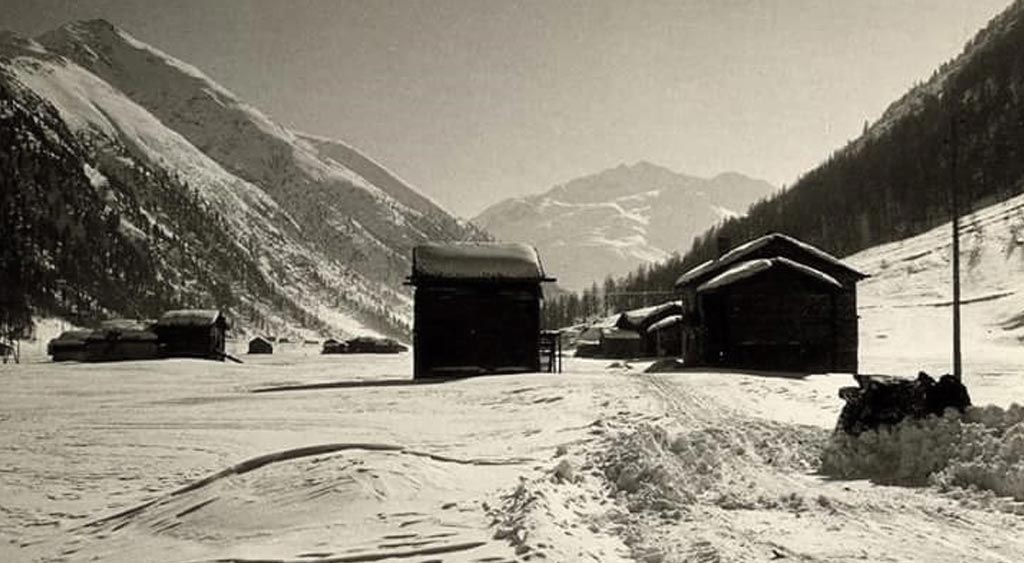
During the winter, after each snowfall, it was the women who would mark the roads, trampling the fresh snow, on their way to the Mass at five in the morning.
In spring the meadows were fertilized, cleaned and prepared for the growth of the new single, vital summer cut of hay, which would feed the cattle for eight long months.
The system of compulsory days also provided for the construction of bridges and the embankment of the river during flood periods.
With these rules, that citizens had freely given themselves to survive all adversities, the Livignaschi led an extremely poor life, producing only the essential to live, in a few cases increased by the income of family members who immigrated to the countries of neighboring Switzerland.
Here, in addition to being paid, they were able to learn new working methods, new construction techniques, and new uses of materials.
They had to wait until 1914 before they could have a drivable road that could connect Livigno directly to Italy, through the Foscagno Pass.
I hope you enjoyed my little summary. If it arouses interest and sympathy, I’m
especially happy!
The book is available in stores. The village and its people are looking forward to your visit today.
I would like to introduce them to you!
Inken
